| Province/Region Bei Yang (Zhili)
Fengtian Guangdong Hubei Jiangnan Jilin Sichuan Zhejiang (Tianjin mint) | English Legend PEI YANG ARSENAL AN-HWEI PROVINCE FUNG-TIEN PROVINCE KWANG-TUNG PROVINCE HU-PEH PROVINCE KIANG NAN PROVINCE KIRIN PROVINCE SZECHUEN PROVINCE CHEH-KIANG PROVINCE ONE DOLLAR | Date TWENTY SECOND YEAR OF KUANG HSÜ (Year 24 of Kuang Hsü ) (Year 24 of Kuang Hsü) Undated Undated Undated (Dragon inside a circle) (1899 in Chinese sexagenary cycle characters) Undated (Year 3 of Xuan Tong) (Year 3 of Xuan Tong) |

Ahad, 27 Jun 2010
Examples of Chinese Dollars


Langgan:
Catatan (Atom)
Kwang-Tung Province, China 1890-1908 Brass 1 Cash Coin

China coin Hupeh Province Ten Cash Y1-F/VF 1902-10

Bronze coins valued at 10 cash (the old coins with a central square hole) or one cent were first minted during the 26th year of Guang Xu (1900) in Guangdong and eventually spread to fifteen bureaus in fourteen provinces by 1905. The reverse design consisted of a variety of dragons, the number of different types being estimated at circa 350. Some of these coins were minted in brass, presumably from melted down cash coins. Smaller numbers were produced with values of 20, 5, 2 and 1 cash and are consequently much harder to find.
CHINA KWANG TUNG TEN CASH COIN P2 OLD AND "RARE"

China coin Kwangtung Province

-Status tidak diketahui-
KING EDWARD VII 1903
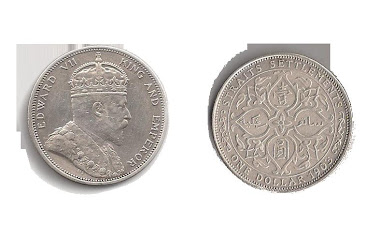
Syiling king Edward VII 1903 ini adalah satu dollar.Memang sukar untuk di jumpai sekarang ini.Keluaran untuk duit bagi nilai ini oleh British dalah terhad.Memang diperbuat daripada silver.Kalau x percaya boleh check e-bay @ internet.
TARIK TALI
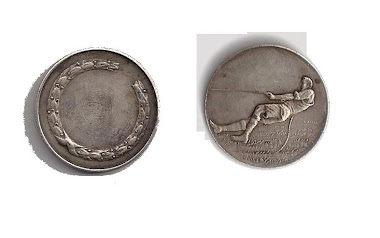
-Status tidak diketahui-
BORNEO
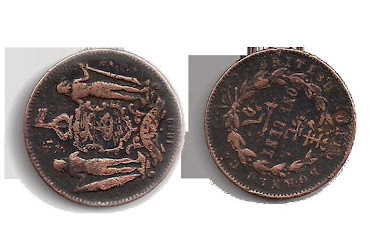
Syiling 1 cent british borneo ini adalah salah satu barang yang ditinggalkan British semasa era penjajahan mereka.Dihasilkan pada tahun 1889 dan diperbuat daripada gangsa.
Early China Tai-Ching-Ti Kuo copper China Coin

In 1905, the designs were changed, replacing the emperor's name with the Chinese characters for Da Qing ("Great Ching") and the two characters either side with Tong Bi ("bronze coin"). These new coins were in four different denominations, valued at 20, 10, 5 and 2 wen (cash) of standard bronze coins and weights of 0.4, 0.2, 0.1 and 0.04 of a tael. These Ta Ching coins, and those that followed, are slightly larger and thicker than the earlier milled coinage. They were first introduced by the Tianjin mint, now renamed as the General Mint of the Ministry of the Interior and Finance, with the reverse legend in English TAI-CHING-TI-KUO COPPER COIN and the emperor's name above in Chinese characters. Similar coins were produced in the provinces. Most bear two Chinese characters, one either side of the obverse denoting the date based on the sexagenary cycle. In the example illustrated below these characters appear in the 3 o'clock and 9 o'clock positions on the obverse and are equivalent to 1907. Coins produced other than in Tianjin usually bear a small mintmark character in the centre of the obverse on a raised circular disc.
ZAMAN ARAB
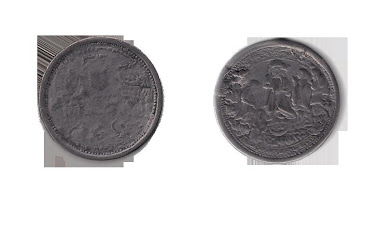
-Status tidak diketahui-
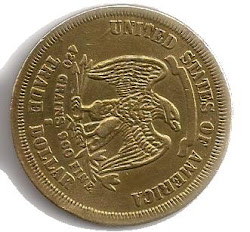
1875 TRADE COIN UNITED STATE AMERICA SILVER 425 GRAINS
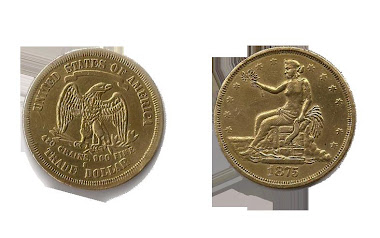
Syiling ini adalah diperbuat daripada silver(perak),di hasilkan pada tahun 1875.Nilainya amat tinggi,dan saya akan menjualnya kepada yang membida dengan harga yang paling tinggi.
CYPRUS_QUEEN VICTORIA__HALF PIASTRE 1900__VERY RARE

BRONZE COIN 1/2 PIASTRE 1900 PORTRAIT : QUEEN VICTORIA CONDITION : VERY FINE